Can you really trade meme coins with just $10 and come out ahead?
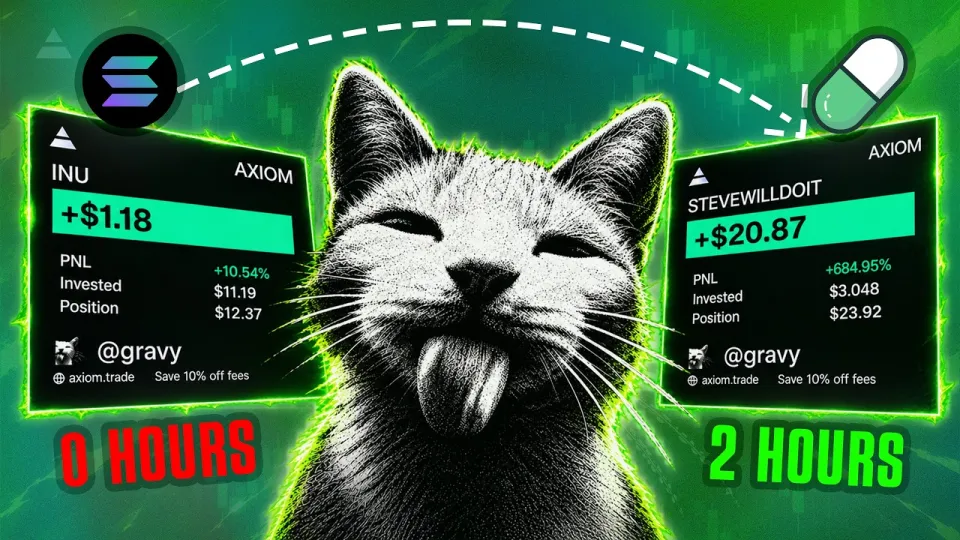
Video: I Tried Trading Memecoins with Just $10
Need articles like this for your video? They help promote it on YouTube and Google — order them in the Telegram bot @sat_sit_bot. The bot writes and publishes the articles itself (with your YouTube video embedded) on popular topical websites (no ads). Try it free: 50 articles on us.
· based on the channel gravy
Meme coin trading with $10 is possible, but the constraint is not the entry — it is the cost structure. Five real Solana trades, each buy kept under 0.05 SOL and routed through Axiom's trading terminal, show that a micro portfolio can survive fees and still catch a narrative, as long as you treat every position as expendable and every exit as mechanical rather than emotional.
What a $10 meme coin portfolio actually looks like on Solana
A $10 portfolio on Solana is roughly 0.05 SOL, which is small enough that a single bad fill can wipe a meaningful share of the account. That is why the experiment in the gravy video used a hard cap: no single buy above 0.05 SOL, five trades total, and every decision documented — why the buy happened, why the sell happened, and which one was fumbled.
The mechanics that eat small accounts are predictable:
- Swap fees and priority fees. Solana transactions are cheap in absolute terms, but a few cents on a $10 order is a percentage point or two before the trade even starts working.
- Slippage on thin liquidity. Newly launched meme coins have shallow pools; a market order can move the price against you on the way in and again on the way out.
- Spread between quoted and realised price. The number on screen is not the number you get when the position is closed.
- Gas for failed transactions. Bots and congestion mean some attempts simply do not land, and the fee is still spent.
None of that makes small-account trading impossible. It makes it a game of tight sizing: if fees are 2–4% round trip, a 20% move is the minimum viable target, and a 10% stop is the maximum sensible risk.
The five trades and the narratives behind them
The experiment rotated through five tickers — STEVEWILLDOIT, NPC, MET (Meteora), PUMPY the Trader and UNTXD — and each one was chosen for a story rather than a chart pattern. That is the core of meme coin selection: a ticker with no narrative has no bid.
- STEVEWILLDOIT is the archetypal "I will do it" coin, a meme format that spreads because the joke is instantly legible. Coins like this live and die on timeline virality.
- NPC belongs to the broader AI-agent and NPC meme wave, where the joke doubles as a comment on automated trading bots.
- MET (Meteora) is a narrative attached to a real Solana liquidity protocol, which gives the ticker a reference point traders can search for.
- PUMPY the Trader leans on the launchpad culture itself — a meme about the people trading memes.
- UNTXD is the low-effort, untexted degen format: minimal branding, maximum irony.
The X Money coin meta that pushed several of these tickers is tied to the e/acc (effective accelerationist) crowd and the Cream narrative — a cluster of accounts that amplify each other, so a single post can create a coordinated bid. Recognising that cluster is more useful than reading a chart on a coin that is two hours old.
Why narrative timing beats technical analysis on new launches
On a coin with hours of price history, the only chart that matters is the social one. Narrative timing means buying when a story is spreading but before the crowd has fully priced it, and selling into the attention spike rather than waiting for a second leg that may never come.
A practical routine for small accounts:
- Curate the feed so it shows traders who post early, not accounts that recap moves after they happen.
- Track who actually moves a ticker — a handful of accounts with real reach matter more than a hundred replies.
- Note when a narrative has already run once; the second attempt usually has less fuel.
- Set an exit before entering. On a $10 position, deciding to "see how it goes" is how a 30% gain becomes a 40% loss.
The most common failure is not picking the wrong coin, it is arriving late and then holding. Buying a dip that never recovers, or selling at a 20–40% loss only to watch the ticker run afterwards, is a timing and exit-discipline problem, not a selection problem.
Common questions from traders starting with a small balance
Small-balance traders tend to hit the same three walls, and each has a workaround.
"I can never find coins with a good narrative." The feed is the problem. If the timeline is full of noise, build a separate list of accounts that consistently post before a ticker trends, and check it manually rather than scrolling a general feed.
"I buy the dip and everyone sells." On a fresh launch, a dip is often the exit liquidity of the first wave. Waiting for a higher low, or for the narrative to reappear with new volume, filters most of these.
"Fees eat my profit." At 0.05 SOL per position, fees are a fixed tax on every attempt. Fewer, better-sized trades beat many tiny ones — and a terminal with fee discounts and cashback, like the one linked in the video description, reduces the drag.
"What was the final result?" The video walks through each trade but does not publish a single total PnL figure, which is exactly the number viewers asked for. The honest takeaway is that process, not a headline return, is what a $10 account can realistically test.
Tools, fees and the referral economy around meme coin trading
Axiom is the Solana trading terminal used for the experiment, and its referral program is built into the workflow: signing up through a referral link typically grants cashback on fees and a discount on trading costs, which matters disproportionately when positions are 0.05 SOL. The same logic applies to any terminal — the tool is not the edge, but the fee schedule is a real variable in the maths.
Two practical notes for anyone copying the setup:
- Compare round-trip cost before choosing a venue. A terminal that saves 15% on fees changes the break-even point on every trade.
- Keep the trading wallet separate from anything holding real balance. Small accounts are usually small because they are experimental, and experiments should not share keys with savings.
Useful links
- Axiom trading terminal with referral cashback: https://axiom.trade/@gravy
- The Trenches Discord: https://discord.gg/W7TqkExcSd
- Discord with free Axiom imports and trade signals (NFA): https://discord.gg/9W5j3XUgYB
- gravy on X: https://x.com/gravyski
- Leverage trading with a 20% futures fee reduction: https://www.bitbase.com/landing-page/trading-earning-Gra?ref=8CYOGY
Final takeaway
Trading meme coins with $10 is a test of discipline, not of capital: cap each buy at 0.05 SOL, pick tickers with a legible narrative, and define the exit before the entry. The five-trade experiment on the gravy channel shows the realistic version of small-account trading — some narratives work, one gets fumbled, and the lesson is in the process rather than a single profit number. Anyone repeating it should start through Axiom with the referral cashback to keep fees from quietly deciding the outcome.
Key takeaways
- The experiment used five real Solana meme coin trades, each buy capped at 0.05 SOL, roughly $10 at the time.
- Tickers covered: STEVEWILLDOIT, NPC, MET (Meteora), PUMPY the Trader and UNTXD.
- Trades were executed through Axiom, a Solana trading terminal with referral cashback and fee discounts.
- The X Money coin meta is tied to the e/acc crowd and the Cream narrative, which is why related tickers ran.
- Fees and slippage on tiny orders are proportionally large, so position sizing matters more than entry timing.
Source: I Tried Trading Memecoins with Just $10 · Markdown version
Questions & answers
Can you actually make money trading meme coins with $10?
Yes, but the ceiling is limited by fees and slippage rather than by opportunity. On a 0.05 SOL position, a round trip can cost a few percent, so a trade needs a 20% move just to be meaningful. The realistic goal for a $10 account is learning execution discipline, not generating income.
How do you find meme coins with a strong narrative before they run?
Build a curated list of accounts that post early and check it manually instead of scrolling a general feed. Track which accounts actually move a ticker, and note whether a narrative has already had one run. A story that is already being recapped by everyone is usually past the entry point.
Why do I keep buying dips that never recover?
On a newly launched meme coin, the first dip is often the exit of the initial buyers rather than a discount. Waiting for a higher low or for volume to return with the narrative filters most of those traps. Deciding the exit level before entering prevents a small loss from becoming a large one.
What does the referral link for the trading terminal actually give you?
Signing up through the Axiom referral link in the video grants cashback on trading fees and a discount on costs. On a $10 portfolio that saving is proportionally significant, because fees are a fixed percentage of every position regardless of size.